What Are The Needs And Expectations Of Interested Parties For ISO 9001?
Interested Parties are those stakeholders who receive your products or services, who may be impacted by them, or those parties who may otherwise have a significant interest in your organization.
Contents

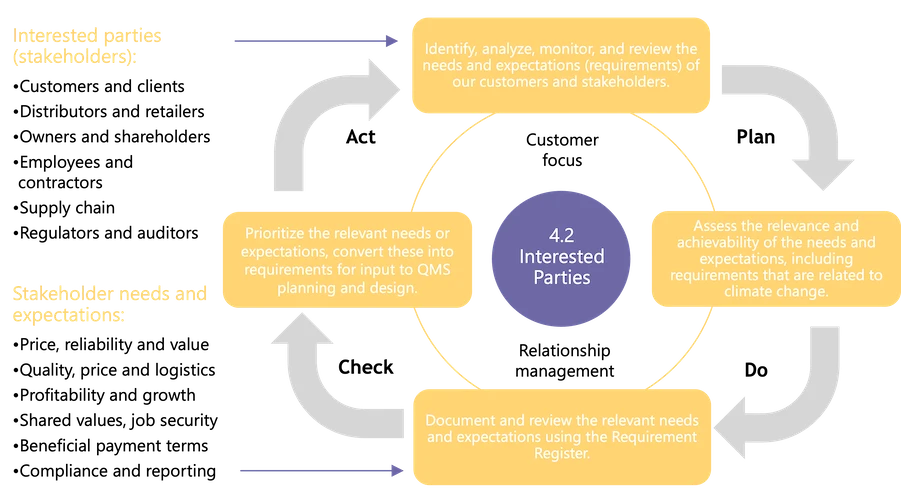
Similar to context review, cross-functional input is vital, as certain functions will identify with particular stakeholders, such as procurement with suppliers and sales with customers.
We should encourage a workshop approach that can be undertaken independently of or in conjunction with the context review workshop.
Once stakeholders and their requirements are identified, the next step is to consider which stakeholder requirements generate legal and compliance obligations for ISO standards. Legal requirements should be determined before other requirements.
You should also determine whether these groups’ requirements are reviewed and updated as changes occur or when changes to your organization’s QMS are planned to meet ISO requirements.

1. Identify your Interested Parties
Ensure that your organization has appropriately identified its interested parties and subsequently determined if any of their needs and expectations are to be adopted as a compliance obligation.
Ensure that this process is revisited periodically because the requirements of relevant interested parties may change over time.
Although not explicitly required for ISO standards, objective evidence could be a list or matrix of the interested parties, their corresponding needs and expectations, and an indication of which of these accepted as compliance obligations might include:
- All relevant legal requirements
- All requirements imposed by upper levels in the organization (for example, corporate requirements)
- All relevant requirements of relevant interested parties that the organization decides to comply with, whether contractually (customers) or voluntarily (environmental or safety commitments)
In order to determine the relevance of an interested party or its requirements, your organization needs to answer the question: ‘Does this interested party, or their requirements, affect the organization’s ability to achieve the intended outcomes of its QMS?’
If yes, the interested parties’ requirements should be captured.

2. Capture Interested Parties’ Requirements
There are many ways to capture this information; your approach might include the following:
- Information summarized as part of inputs to risk and opportunity registers
- Recorded in a simple spreadsheet
- Logged and maintained in a database
- Captured and recorded through key meetings
- Requirements for products
- Gap analysis or internal audit output by Internal Auditors
Departmental Managers should identify and list the needs and expectations of any interested parties in relation to their department that may potentially impact the achievement of your organization’s objectives and policy, the conformity of our products, services and management system.
Also, you should map out and understand relevant parties' expectations and how you plan to deal with their requirements through the management system.
This information should be retained as a strategy or tactical planning document to underpin your organization’s policies and to provide a road map to achieve future goals.

3. Managing the Needs and Expectations of Interested Parties
Based on a scoring output, consider and implement handling approaches to manage and comply with the needs and expectations of our interested parties.
Top Management should review the output for acceptance and incorporation into the QMS in addition to the scope or incorporation into customer requirements, operational activities, process controls, hazard and aspect registers, risk and opportunity registers, and legal and compliance registers.
We suggest you rank the interested parties' requirements according to their degree of Priority and Relevance (e.g., 1 low, 5 high) to current objectives, policies and conformity of products and services as relevant to your QMS.

4. Communication with Stakeholders
Communicating with stakeholders, particularly regarding legal and compliance obligations, is vital. Communication with stakeholders should be based on performance data generated by your QMS, which will require robust monitoring and measurement to ensure the data's reliability.
You should ensure that a monitoring and measurement process is included in the internal audit program (which leads to corrective action) so your organization can ensure that the checking processes are validated and that the data it is communicating is accurate.
Start with Expert Templates, then Make Them Yours

In Summary
‘Understanding the Needs and Expectations of Interested Parties’ is a new requirement for ISO certification. You should allow additional time to prepare for each audit to establish a suitable understanding of the relevant interests of interested parties that impact the QMS.
If this differs from the perception, you should be prepared to challenge this.
Look for evidence that the organization has undergone a process to initially identify examples of interested parties and then to identify any of their requirements of interested parties that are relevant to your organization’s quality management system.
It would be best to determine whether these groups’ requirements are reviewed and updated as their requirements change (continual improvement), or when changes to your organization’s QMS are planned.

Related Information You Might Find Useful
- 4.2 Understanding the Needs and Expectations of Interested Parties [ISO 14001]
- 4.2 Understanding the Needs and Expectations of Interested Parties [ISO 45001]

 ISO 9001
 Process Maps
 Reports & Forms