

What Is A Quality Manual?
A quality manual is a high-level document that deploys the quality policy by describing the framework and principles of how an organization intends to plan and manage its quality management system processes. As a communication tool aimed at stakeholders, quality manuals include information about an organization’s administrative and technical operations and its strategic direction, goals, and mission.
Contents
- What is a Quality Manual?
- What Are The Benefits Of A Quality Manual?
- What Is A Quality Manual Template?
- Does It Matter How Long The Quality Manual Is?
- Should The Manual’s Headings Match ISO 9001?
- How Should I Assign Document Numbers And Their Sequence?
- Read Other Quality Manual Examples
- What’s The Best Writing Style For A Quality Manual
- What Should Be Included In A Quality Manual?
- What Procedures Should I Document?
- Why Would You Document More Procedures?
- Final Tips for Creating Your Manual
Distributing your quality manual to prospective customers will inspire confidence in your business’s products or services.
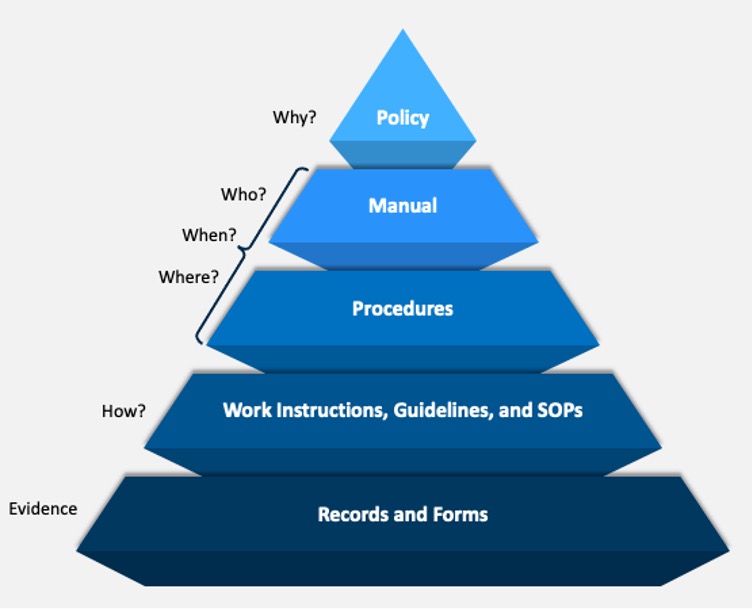
What A Quality Manual Is Not
There is an essential distinction between the quality management system (QMS) and the quality manual.
The quality management system is an entire network of policies, documents, business processes, codes of practice, guidelines, and procedures that organizations might use to manage their quality control, operational, and assurance functions.
The quality manual is a single, high-level document describing the whole quality management system, like a handbook, rather than being the management system itself. Sometimes, a quality management system will include a quality manual, and sometimes the quality manual is not included.
What Is The Status Of The Quality Manual In ISO 9001?
Although it is recognized that the quality manual is no longer required in ISO 9001, many businesses choose to retain and update their quality manuals, since their employees, customers, suppliers, and other stakeholders perceive its value and status in understanding their operations.
Some organizations wonder whether developing such a seemingly complicated document for their business is worth it. If your business does not have a quality manual, ensure that the scope statement from Clause 4.3, which is usually contained within the quality manual, is available to interested parties via your website or other means.
Learn more about the ISO 9001 requirements and mandatory documents.

What Are The Benefits Of A Quality Manual?
The quality manual offers a wide range of benefits for organizations. It is organized, easy to follow, and covers almost everything you and your employees need to know about the ISO 9001 standard and what is expected of your quality management system.
The quality manual describes an organization’s quality management system and helps delineate authorities, interrelationships, and the responsibilities of personnel within the system. The quality manual also references the procedures, forms, and activities comprising the quality management system. It addresses how customer satisfaction is achieved and how conformity to applicable regulatory and statutory requirements is assured.
The quality manual helps familiarize customers and other external organizations or individuals with the quality controls an organization has implemented. The controls defined will demonstrate to all interested parties that the management system is focused on implementing processes that deliver customer satisfaction and process efficiency.
Distributing your quality manual to prospective customers will inspire confidence in your business’s products or services. You will find that some large multinational businesses will not even let you bid for their business unless you are ISO 9001 certified.
It is also helpful as an induction tool for new staff and a road map for the quality management system's operation. Some of the other benefits the manual offers organizations include:
- Improved quality management systems
- Easier transition to ISO 9001 operations
- More effortless adjustment to updated ISO 9001 standards
- Guidance in increasing efficiency and improving processes
The quality manual formally documents the processes and practices by which customer satisfaction is delivered and is primarily used as a source of information regarding your quality management system and during ISO certification. However, it also provides the following information:
- Sets expectations for both management and employees
- States the purpose of the organization and its quality policy, objectives, and scope
- Guidance on having clear and concise communication throughout the organization
- Becomes the top-level document in the documentation structure and leads to the next-level documents
- A system manual may be helpful to employees if it describes how their organization works as a system and how the system is monitored, reviewed, and improved
- Captures the various processes and interactions, which gives a bird's-eye view to the user about the organization
- Provides company context for internal, customer, and ISO certification body auditors new to the organization
- Demonstrates the organization’s plan to conform to the latest ISO 9001 standard
- Demonstrates ISO 9001’s Clause 5.3 in that all organizational roles, responsibilities, and authorities have been assigned, communicated, and understood
- Serves as a form of evidence for auditors — those doing certification audits, the lead auditor, and internal auditor(s)
Whether your business is in manufacturing, healthcare, construction, or tech, a well-structured quality manual will help streamline operations and boost credibility amongst suppliers, customers, clients, and other stakeholders.
Why Reinvent the Wheel?

What Is A Quality Manual Template?
A quality manual template is a customizable document framework used to create an organization's quality manual, the top-level guide that describes its Quality Management System (QMS). It outlines the system's scope, policies, procedures, and management responsibilities.
It serves as a roadmap for internal staff, a guide for auditors, and a reference for customers to ensure consistent product or service quality and regulatory compliance. The key contents of a quality manual include:
- Introduction & Scope
- Quality Management Principles
- References and Definitions
- Context
- Leadership
- Planning
- Support
- Operation
- Performance
- Improvement
- Appendices
The quality management templates include manuals, procedures, internal audit checklists, and forms that are known to meet the requirements of ISO 9001 and align with the needs of industry. Our QMS templates helped many businesses achieve certification. Why not yours in 2025 and beyond?
Jump Start Your Documentation
Does It Matter How Long The Quality Manual Is?
No, it does not matter how long your quality manual is. However, you don’t want to overwhelm your readers with too much detail and extraneous information. You also want to ensure that all applicable requirements are described and the clauses are covered without confusion.
We've prepared 10-page quality manuals and other manuals with more than 150 pages that include all the documented procedures and forms. Each version of the quality manual and QMS was certified because it met the requirements, not because it was a certain page length.
A well-written quality manual acts as an interface between the generic standard and the requirements deployed by your business’s management system. It conveys how the quality management system works and what controls are in place to manage each process. Therefore, your organization's size, context, complexity, and the extent of its individual processes will heavily influence the content volume in the quality manual.
PRO TIP! You need to write a quality manual so that the intended audience will use it. The primary audience should never be the External Auditor. A good quality manual document has a clear purpose (is it easy to follow?) and a targeted audience (is it beneficial for stakeholders?). It is then written and designed to meet contextual expectations.
What If My Boss Wants A 4-page Quality Manual?
Manage expectations - Most organizations prepare a quality manual that covers the requirements of the international standard, includes or references the necessary operational procedures, and outlines the basic requirements related to your business’s operations. Addressing all the requirements in three or four pages would be complicated.
Most quality manuals are 30 or 40 pages long. Our quality manual template addresses each quality requirement in 37 pages of text, while the quality procedures (supplied as separate documents) define how compliance is achieved at an operational level.
The quality management system information could be included in other business documents, such as an Operations Manual, Company Guidance document, or Business Systems Manual. Remember to reference the process maps, quality procedures, forms, and work instructions in whatever you use as a ‘quality manual’.
The key is to decide who needs to read the quality manual and write the content for them. Most internal auditors, regulatory bodies, suppliers, employees, and customers who will likely read your quality manual will know what they seek. To add value, you need to decide what is helpful to your organization in meeting your unique needs and in your unique context.
We recommend a quality manual that generally addresses each section of the standard, but if you think a 3-to-4-page summary document with links to the lower-level procedures and forms will fulfill your organization’s needs, go for it! Ideally, you should include an appendix in the form of a matrix showing how the sections of your quality manual align with the standard’s clauses.
PRO TIP! Ask your business partners, suppliers, and customers for a PDF copy of their quality manual if they are ISO 9001 certified. Reviewing these with your colleagues (Boss / Top Management) might be helpful — particularly those new to ISO 9001. It will help inform and manage their expectations while providing a benchmark for your industry.

Should The Manual’s Headings Match ISO 9001?
If your External Auditor has stated that the quality manual’s headings must be numbered according to the ISO 9001 clause numbers, ask them to show you the requirement in the standard. It is not a requirement but simply a recommendation.
People often argue that you should create a quality manual based on your operations, not the standard's numbering system. Linking the quality manual to the clause numbers acts as a helpful cross-reference in the early stages of implementing ISO 9001, and doing so might create more work when the standard is revised.
PRO TIP! Though this extra work helps you look more closely at the standard clauses, making sure you did not miss anything, keeping such references can be helpful for an External Auditor and new employees, but might also be beneficial for management!
As such, the heading titles and numbering used in our quality manual template relate to the standard for ease of reference.

How Should I Assign Document Numbers And Their Sequence?
We use the same numbering sequence as ISO 9001 in our quality manuals. You are free to replace these with a system that works best for your staff and the business — as long as the system is logical, documented, and communicated, it should be more than adequate.
We find it more accessible for external auditors during certification audits if it is the same as the ISO standards. The lead auditor and other internal auditors often comment that it is easier for documentation and records to have the same number and sequence as the requirements of ISO 9001.
PRO TIP!
- Ask your business partners and suppliers for a PDF of their quality manual. You will find these invaluable, and they will help Top Management envisage the work to be done
- It will benefit the business if your quality manual is compatible with your most trusted business partners; if possible, try to develop your documentation according to a similar outline

Read Other Quality Manual Examples
We recommend that clients gather and review several relevant quality manuals before starting their documentation.
- Ask your business partners, suppliers, and customers for a PDF copy of their business quality manual
- Download a sample of our Quality Manual Example PDF
- Search online
Many quality manual examples are available online - some good, some poor... so you must be careful and use your best judgment. Here are some TIPS:
- Search for a PDF (after the search term, type filetype:pdf)
- Search for a top competitor's quality manual or a Top 10 company in your industry. E.G., 'Siemens ISO 9001 quality manual filetype:pdf'
- Search terms such as 'ISO manual', 'ISO quality manual', 'ISO 9001 Manual', 'ISO 9001 quality manual', 'quality systems manual', 'quality management manual'
- Check the URL, make sure the PDF is coming from their website and not some 3rd-party upload site (it could be fake)
- Check the date - look for quality manuals written in the past year or so (and certainly not the 'old' 2008 version!)
- Ensure the quality manual has passed ISO 9001 certification. How do I check if a company is ISO 9001 certified
- Try to look for 'long' and 'short' examples if you can

What’s The Best Writing Style For A Quality Manual
By ensuring your quality manual is easy to read and understand, without too much jargon specific to your industry, your quality manual will be informative and concise. The best writing style for any quality manual uses broken-up sentences with informative images that describe what is done in the present tense to describe the process as it is meant to happen.
The content of our quality manual and procedure templates is clearly articulated using future progressive tense phraseology to describe the sequence of steps, actions, and outputs as they are meant to happen.
Finally, your quality manual should be presented professionally. Use your branding for the design and layout (this is where templates that use styles, such as ours, are ideal). Distribute in PDF format, consistently including the date and/or version number in the filename or metadata.
PRO TIP! Write in a clear and unambiguous active voice style. The quality manual and procedures use the verbs 'will' and 'must' instead of 'shall' or 'should', which express an expectation of what has to happen in the present or future. This implies the willingness of someone to undertake the task and conveys the typical behavior of the things that must be done.

What Should Be Included In A Quality Manual?
The ISO 9001 standard and requirements for QMS documentation are very clear. It is, therefore, easier for all involved (internal and external — such as business partners, suppliers, and ISO auditors) if the quality manual’s table of contents is similar to or mirrors the requirements. As such, we recommend:
Overview Of The Quality Management System
The figure below illustrates a methodology for developing a quality management system, using the plan, do, check, and act process approach to implement and deliver management system objectives and stakeholder requirements to achieve compliance.
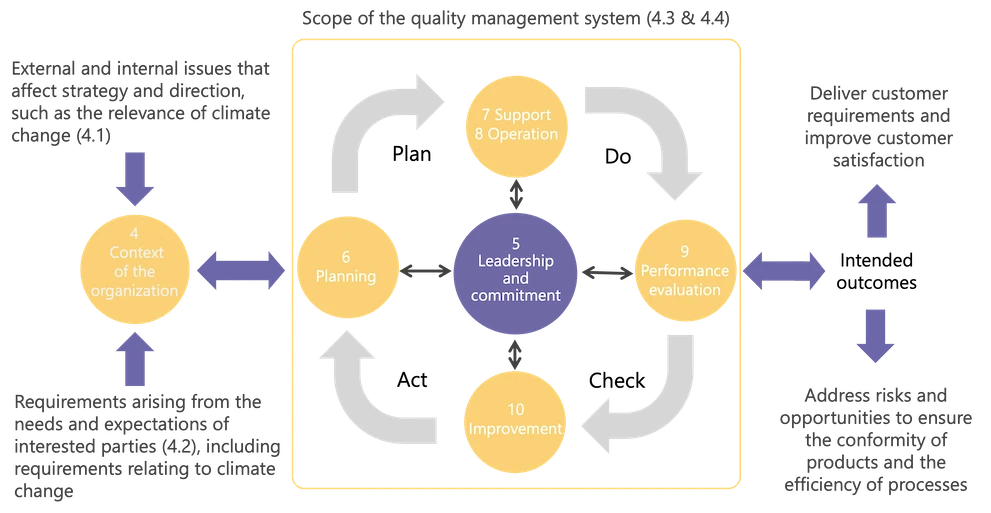
Certification to ISO 9001 will help achieve these intended outcomes and demonstrate that the quality management system effectively provides value for your organization and its interested parties.

Context Of The Organization
Understanding Organizational Context
The context of the organization section contains extensive information about various issues that may arise while implementing or updating the quality systems documentation. This section also features strategies for overcoming such issues.
Internal issues – conditions related to organizational activities, products, services, strategic direction, culture, people, knowledge, processes, and systems. Using SWOT analysis will provide businesses with a framework for reviewing and evaluating their strategies, the position and direction of the organization, business propositions, and other ideas.
External issues – conditions related to cultural, social, political, legal, regulatory, financial, technological, economic, relevance of climate change, competition at local, national, or international levels. Using PESTLE analysis will provide businesses with a framework for measuring their market and growth potential.
The output from understanding the organizational context must be evident as an input when considering risks and opportunities and the actions taken to address them. Understanding the context and formally addressing identified issues will help ensure the quality management system's ongoing viability and credibility.
Needs And Expectations Of Interested Parties
Your organization has a unique set of interested parties whose needs and expectations, some of which may relate to climate change, will develop over time, and only a limited set of their respective needs and expectations apply to your operations or the quality management system. Such needs and expectations broadly include those shown in the figure below.
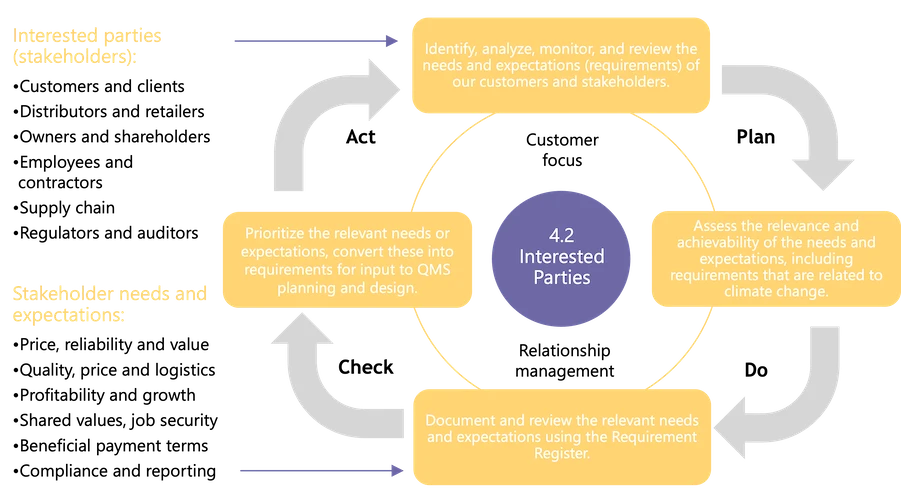
The organization must identify and address any statutory or regulatory requirements associated with interested parties, as appropriate. Businesses must ensure their products and processes meet all relevant requirements and identify and assess the potential impact of any relevant needs and expectations that may be elicited from interested parties.
Where appropriate, to ensure that your processes are aligned to deliver the requirements of your interested parties, we convert relevant needs and expectations into requirements that become inputs to your management system and your product and service designs.
Management System Scope
The definition of the scope is a key component of any quality management system. It provides the boundaries as to what is within the scope when it comes to developing, implementing, and auditing the QMS.
The scope is usually meticulously articulated on the certification of compliance to ensure there is no confusion as to what sections and activities of the quality management system comply with ISO 9001:2015.
Learn more about how to write your scope
Also, mention exclusions for your business rather than omitting them entirely. Some ISO 9001:2015 requirements, such as Clause 8.3 Design and Development, may not apply to your specific organization. Exclusions must be limited to Clause 8 of ISO 9001 and must be justified and must not affect the organization’s ability to meet customer, statutory, and regulatory requirements.
Management System Processes
Organizations often implement their quality management system in a broader management landscape of technical, administrative, and operational domains.
Organizations should adopt the process approach advocated by ISO 9001:2015 and ISO 9000:2015 to achieve this. Using the PDCA cycle to manage processes and stimulate improvement by incorporating the ‘process approach’ into your planning and operations.
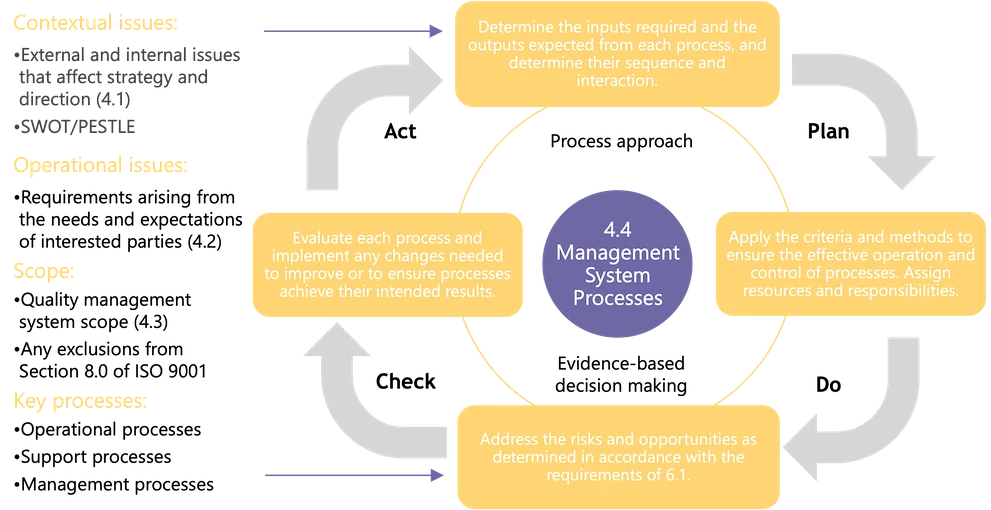
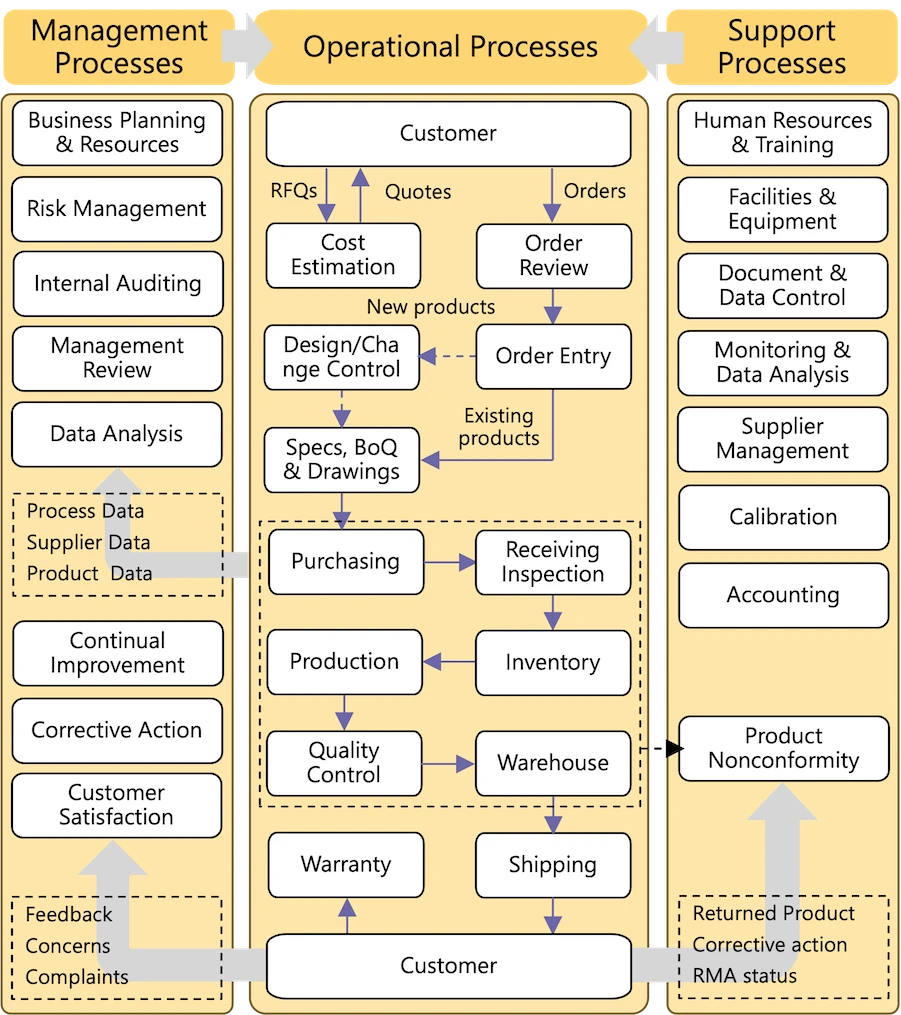
Organizations can ensure that management system effectiveness is established, monitored, maintained, and improved by managing the inputs, activities, controls, outputs, and interfaces. The process landscape should be described and reported using documented procedures, process maps, turtle diagrams, matrices, schedules, charts, etc. The process landscape is defined by three key process groups and their sub-processes, as shown in the table above.

Leadership
Leadership And Commitment
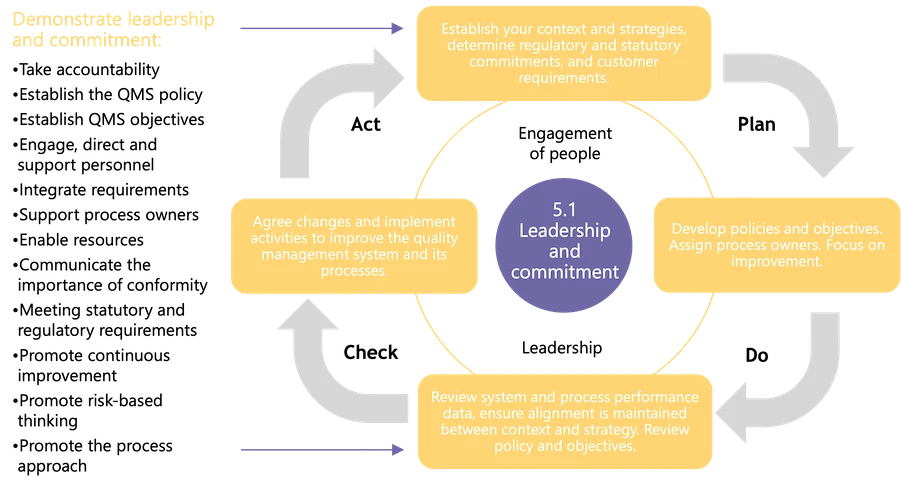
Leadership is one of the biggest principles expressed by the ISO 9001 standard. This is who is responsible for ensuring that the development and implementation of your quality management system policies are going according to plan.
Top management is responsible for overseeing and implementing your organization’s new quality management system and control of documents. Some of their responsibilities will include directing strategies and providing communication in processes and performance.
They will also need to make sure that resources for ISO implementation are allocated to areas that need more focus on improvement and that responsibilities are distributed to the right people or departments.
For example, leadership may need to ensure that the quality manager has the necessary resources, such as finances or technology, to initiate and complete processes successfully.
In the PDCA (plan-do-check-act) cycle, there are four different phases that leaders must go through. These steps are:
- Plan — This is when strategies are developed to implement or improve the quality systems. Leaders must ensure that these strategies are followed through.
- Do — Leaders must ensure that each step of the developed strategy is performed correctly. In this phase, they must check resources and the distribution of tasks to ensure they align with QMS needs. They may also monitor improvement, assess risks or problems, or review the outcome of recent QMS changes.
- Check — This essentially reviews everything done during the “Do” step. It will include checking the system’s performance, ensuring it is working correctly, and making changes that have been implemented. Policies and other documentation will also be under review.
- Act — The final part of the cycle is acting. This phase involves ensuring that all changes made for improvement have been implemented and removing any processes or changes that previously provided negative results.
An organization's governance structure is also a large part of the quality manual’s leadership chapter. This section of the quality manual should discuss what the company defines as “proper support” to ensure processes can complete objectives under the ISO 9001 quality standards.
The organization's governing leaders are also responsible for verifying the system through internal audits and data reviews.
Leaders with this responsibility should examine current trends and identify risks that the organization should plan to overcome. Most importantly, they should continuously monitor the effectiveness of the quality management system and any improvements or successes it achieves.
Customer Focus
Top management must now take the lead role in demonstrating a commitment to customers. In particular, customer requirements and statutory and regulatory requirements must be identified, understood, and consistently addressed.
Any potential risks that threaten the continuity of services and products and the level of customer satisfaction should be mitigated.
In addition, top management must also ensure the quality management system remains focused on delivering conforming products and services, meeting its statutory and regulatory obligations, and enhancing customer satisfaction.
Quality Policy
The quality policy is a key document of the quality management system. It is important to note that there is emphasis on the quality policy being appropriate to the organizational context and strategic direction, as well as to the purpose of the QMS.
The quality policy will also provide a broad framework for setting quality management system objectives. Top management needs to lead the establishment, creation, review, and ongoing maintenance of a quality policy that is relevant to activities.
The quality policy must be readily available to stakeholders and the quality management system, and careful consideration must be given to how this is done.
Roles, Responsibilities, and Authorities
The Top management team must ensure that organizational roles, responsibilities, and authorities are defined and communicated within the quality management system.
The responsibilities and authority of each employee should be clearly defined and made available to all staff. Top management must ensure that someone is tasked with preserving the integrity of the quality management system while planning and undergoing change.
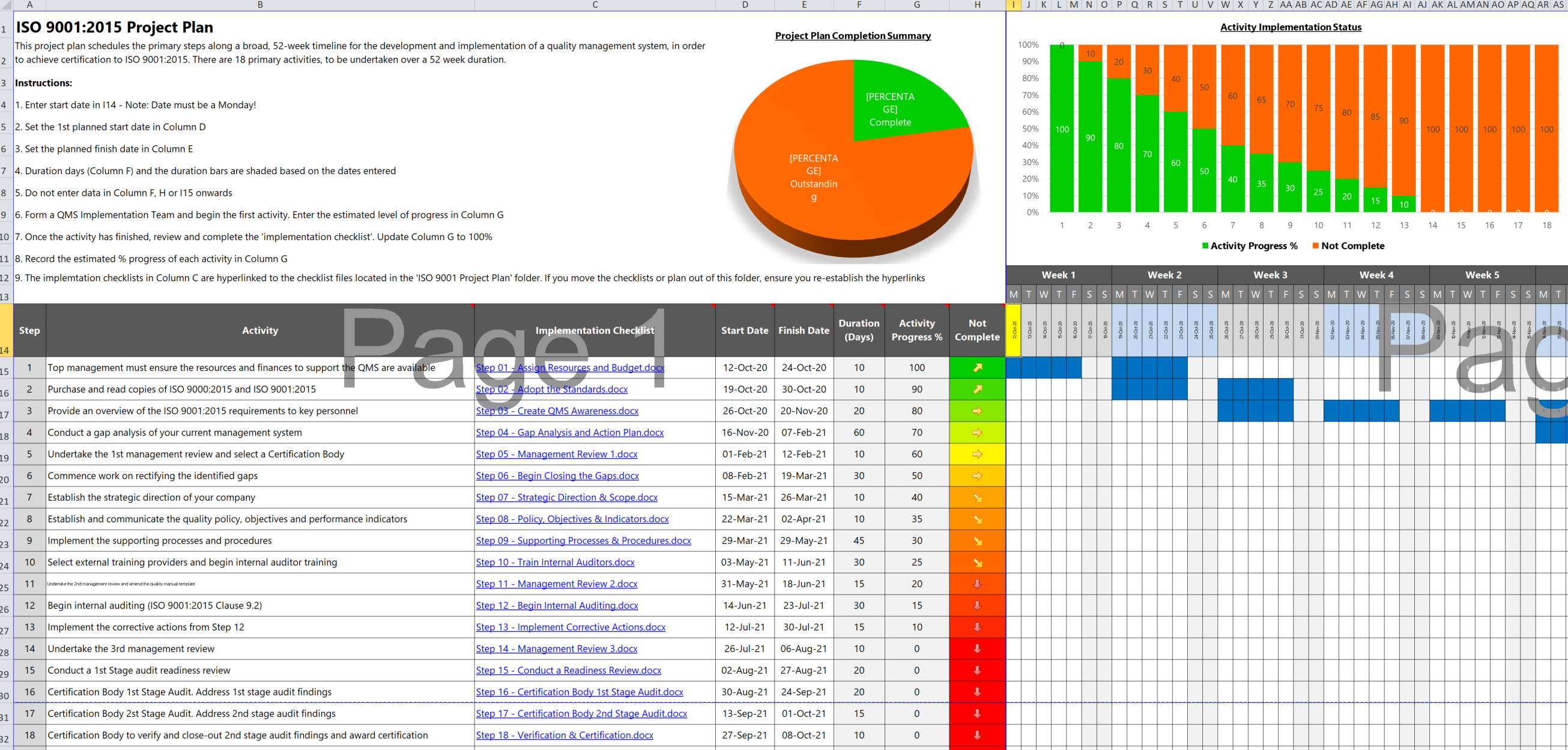
Planning
Actions To Address Risks And Opportunities
Top management is responsible for implementing a risk-based mindset within your organization. They are in charge of establishing procedures and planning around risk management and ensuring that your organization’s principles are included in your quality management system.
Top management will also be expected to provide the resources necessary to cover any processes within their departments and plan and assign responsibilities for ISO certification.
Determining the risks and opportunities flows directly from the context analysis in Clause 4.1. Addressing the risks (in particular) and opportunities will ensure the quality management system achieves its planned objectives.
Note 1 of this clause provides options for mitigating risks, and note 2 provides methods for capturing opportunities and potential outcomes. Subclause 6.1.2 highlights the need for a planned approach; the associated actions should be integrated into the quality management system, and their effectiveness should be evaluated.
Quality Objectives And Planning To Achieve Them
This section of the quality manual requires quality objectives for relevant functions, levels, and organizational processes.
Ensuring that the quality objectives and associated key performance indicators (KPIs) are consistent with the quality policy (see clause 5.2), relevant to the products and services, and demonstrate that they meet or exceed customer expectations is essential.
Subclauses 6.2.1 and 6.2.2 provide precise requirements regarding the quality objectives and how to achieve them. It should also be noted that externally provided processes, products, and services may require quality objectives.
Planning Of Changes
When changes to the quality management system are required, they must be planned and systematic. Due consideration should be given to what the change is trying to achieve and any potential consequences (positive or negative), while ensuring that the overall integrity of the management system is maintained.
Other issues that need to be considered include whether sufficient resources are available and the potential impact on any roles and responsibilities. Ensure that documented information related to planned changes and their potential impact on the quality management system is maintained.

Support
General
General support includes human and financial resources and the working environment. Ensuring that your employees are satisfied with their work environment is essential. With comfort, efficiency, and productivity in the workplace, your employees will produce more quality products and services. Your customers will thank you later!
People
Focus on ensuring the organization has the personnel to implement and maintain the quality management system effectively. This clause emphasizes the need for the organization to determine the necessary competence of people in terms of skills and awareness to carry out work that affects the quality of products or services.
Job descriptions are designed to include all the qualifications and experience your organization requires from ideal candidates for a specific position. Descriptions also include a general list of responsibilities that come with the role. Creating an accurate job description will help you filter out candidates more effectively, saving both applicants and hiring managers time and effort.
Human resources is required in the hiring process because they often hold records for employee qualifications. They also have documentation and training materials that new employees need to know when performing their roles effectively and efficiently. Having human resources involved makes the hiring process go more smoothly.
Infrastructure
Organizations need building blocks and blueprints to succeed, and the quality manual's infrastructure section does a great job of covering this.
Providing and maintaining necessary resources to departments is vital for a successful working environment, whether physical workspaces or software. Quality and facility managers are often the brains behind this process, ensuring operations are completed successfully.
Operational Environment
This subclause focuses on the organization’s need to “determine, provide and maintain” a suitable environment for the operation of processes.
This subclause notes that a suitable environment can be a combination of physical, social, psychological, environmental, and other factors, including temperature, cleanliness, prevention of staff burnout, etc.
Calibrated Equipment
This subclause focuses on monitoring and measuring activities to demonstrate that products and services meet requirements. There must be an appropriate level of resourcing to ensure that the monitoring and measuring is suitable for the activity and will provide valid and reliable results.
Maintaining the resources needed for monitoring or measuring is essential to ensure they remain fit for purpose. Appropriate documented information (records) must be maintained.
Organizational Knowledge
This subclause focuses on ensuring the organization captures and preserves knowledge, which underpins processes and ensures the quality of products and services. It emphasizes the need to ensure that the knowledge is contemporary and reflects current needs and trends; if not, the additional knowledge should be obtained.
Competence
Establishing and documenting levels of competence is a key clause and is fundamental to the organization. Once determined, the organization must ensure the staff is competent through appropriate education, training, or experience.
If competence needs to be acquired, the organization must take the appropriate action to do so. A follow-up evaluation of the effectiveness of the action taken needs to be documented.
Awareness
Awareness has been elevated to a clause in its own right. It should also be noted that, as with clause 7.2, it applies to all persons doing work under the QMS’s control. Subparagraphs (a)–(d) of the clause state that employees shall be aware of the quality policy, the objectives, their contribution to the effectiveness of the quality management system, and the implications of not conforming.
Communication
This clause focuses on all internal and external communication relating to the organization’s quality management system. The clause clearly articulates, in subparagraphs (a)–(e), specific requirements for internal and external communication.
Keeping communication active between your organization and customers will help improve satisfaction and reduce any concerns they may have. The customer service team, liaising with the sales and marketing department, is responsible for ensuring a line of communication always exists between you and the customer.
There are many ways you can maintain communication with customers, including:
- Letters, direct mail, response forms
- Surveys
- Website feedback
- Customer services
- Social Media
- Apps
Of course, with emerging new technology and social media, organizations must keep up-to-date with how their customers would like to communicate with them. Make it easy for them to use the channel they prefer best.
It should be noted that there is a customer-specific communication subclause (8.2.1), which also needs to be addressed.
Documented Information
Subclause 7.5.1 includes all documented information identified as a requirement of ISO 9001:2015 and that is required for the effective operation of the QMS.
The subclause notes that the extent of documented information can differ between QMSs due to their size, complexity, products and services, and staff competency.

Operation
Operational Planning And Control
Managing operations is one of the most complex parts of implementing a new quality management system, as it requires a lot of time and energy to ensure its success. While your organization plans operations, specific operational details will need to be reviewed, including:
- Objectives and requirements for the product or service
- Verification, validation, monitoring, inspection, and test requirements
- Documented information to demonstrate conformity
- Related life risks and opportunities
- Documented information to demonstrate conformity and control of nonconforming products
- Necessary resources or outsourced processes and their controls
- Criteria for process performance and product or service acceptance
- Potential consequences and mitigation of changes affecting input requirements
- Resources necessary to support the ongoing operation and maintenance of the product
This clause articulates the requirements for the planning, implementing, and controlling processes. The clause is strongly linked to the requirements addressed in several clauses, particularly Clauses 4.4, 6, and 8.4.
Customer Requirements
Understanding and meeting customer requirements is crucial. As mentioned earlier, ensuring customers are satisfied with what they receive from your business, whether a product or service, is essential to a company’s success.
Customer complaints should be documented and fed into the continuous improvement process or the control of nonconforming processes. In fact, the ISO recommends exceeding your customers’ expectations to ensure continual growth and success.
Identification of any applicable statutory and regulatory requirements that apply to the products and services being offered is crucial.
Ensuring the quality management system can meet the claims it makes on the products and services it intends to offer is vital to the ongoing credibility of the QMS. It is crucial that all reviews of customer requirements are documented and retained, and that any changes to requirements, products, and services are communicated to relevant stakeholders.
Design And Development
This clause focuses on the quality management system, establishing, implementing, and maintaining a design and development process appropriate to providing products and services.
External Processes, Products, And Services
This clause ensures that externally provided processes, products, or services meet the requirements of the quality management system. It places an explicit requirement on the quality management system to ensure that externally provided processes, products, or services meet QMS requirements.
It is also a requirement to determine the criteria to evaluate and select external providers and to monitor and evaluate their performance. The quality management system must retain documented information as evidence of external provider evaluations.
Product And Service Provision
Subclause 8.5 requires the quality management system to control how the organization’s products are produced and the services provided. The subparagraphs clearly articulate the requirements for control of production and service provision.
It should be noted that this clause is closely linked to some other clauses (and their subclauses), including clauses 5.2, 7.1, 7.2, 7.4, and 8.2.
Release Of Products And Services
This clause requires the quality management system to have well-documented practices and procedures for releasing products and services. It is essential to have well-documented practices and procedures that clearly delineate, as appropriate, the approval for the release of products.
Nonconforming Outputs
This quality manual clause focuses on identifying products or services that do not conform to their intended requirements. Requirements also include establishing controls to ensure that nonconforming products are not delivered to the customer or that their unintended use is prevented.
When nonconforming products are identified, the quality management system must take appropriate action to rectify and document the nonconformance.

Performance Evaluation
Monitoring, Measurement, Analysis, And Evaluation
Owners are always anxious to see performance evaluations. However, it is vital to regularly review your business’s performance rate to know which facets of your quality systems are working correctly and which aren’t so that you can make improvements later.
The focus of subclause 9.1.1 is determining what it needs to monitor and measure, and how it will carry out these activities to ensure the results obtained are valid. The objectives and KPIs established under clause 6.2 will provide valuable input into addressing this clause.
Various methods exist for developing and responding to performance evaluation, including identifying nonconformity trends, creating and implementing corrective actions, and reviewing requirements set out by the quality management system and ISO 9001.
Customer Satisfaction
We’ve already discussed customer satisfaction quite a bit, but it is next on the ISO requirements list and should be part of your documentation and records. This subclause requires the quality management system to put in place arrangements to monitor levels of customer satisfaction.
Your rating should be monitored monthly, at the very least. Various analysis techniques can be applied to review the data. Whether failures or successes, feedback should be followed up on through customer communication.
As mentioned before, customer satisfaction directly affects sales and profit, which should always be your goal when growing the business.
Analysis And Evaluation
Analysis refers to examining the collected data to identify trends, patterns, or areas of concern per ISO 9001:2015 Clause 9.1.3. Data analysis is a key element of ISO 9001, particularly in customer satisfaction monitoring, process performance, and decision-making based on evidence.
This can include data on customer feedback, internal audits, process performance, nonconformities, corrective actions, and product conformity. The analysis helps determine trends, spot issues before they become significant, and proactively take corrective actions.
The goal of analysis is to gain insights into the underlying causes of performance and to guide decision-making for improvement. Organizations can employ various statistical and analytical methods to support data analysis under ISO 9001. Data should also be analyzed to identify the root causes of problems or inefficiencies in processes, products, or services.
Subparagraphs (a)–(g) provide a clear framework of what needs to be evaluated. The objectives and KPIs established under clause 6.2 to achieve them will provide useful input into addressing this clause.
Internal Audit
Subclauses 9.2.1 and 9.2.2 of this clause and their associated subparagraphs provide a clear framework for conducting internal audits.
Auditing ensures that the quality management system and processes are aligned and that new and improved techniques become standard practice.
All audits should be conducted positively and non-threatening; otherwise, they will be a waste of time. Audits should help the quality management system improve, and should not be conducted just to fulfill the certification process requirements.
Management Review
Clause 9.3 requires reviews of the quality management system to be conducted by top management at planned intervals to ensure ongoing suitability and effectiveness. Top management involvement in management review meetings, preferably as chairperson, is fundamental to the success of any quality management system.

Improvement
Improvement - General
Last but not least, in the quality manual, the last requirement includes improvement. The quality manager is one of the more critical roles in this section, responsible for using evaluation tools to assess the QMS and develop improvement recommendations.
This clause clearly focuses on improvement, which is underpinned by meeting customer needs and enhancing customer satisfaction.
Your organization should also ensure that the data analyzed relates to your quality management system and to short-term and long-term improvement.
Nonconformity And Corrective Action
Where applicable, any corrective action taken and controls implemented to eliminate the cause of nonconformity are applied to other similar processes. Corrective action reports should be issued for repetitive, ongoing problems during production and issues that significantly impact the customer, end product delivery, or the management system.
This clause states the requirements for the occurrence of a nonconformity. Appropriate statistical and non-statistical techniques can be applied to analyze nonconformity. The organization will select the appropriate methodology based on the problem's complexity.
Many types of data inputs could relate to the success of your quality management system, including supplier performance, internal and external audit results, and risk and opportunity evaluation. The quality manager often checks these data inputs as they become available.
Continual Improvement
Organizations must be able to demonstrate continual improvement. Most auditors would expect you to revise the quality system documentation and processes as the quality management system matures or when a new process is implemented.
Suppose changes are required to ensure continual improvement in your organization’s processes. In that case, the quality manager may recommend a series of corrective actions that must be performed before your next audit or performance evaluation. The management review process will assess the success of these corrective actions.
This clause requires the quality management system to continually improve and specifically use the outputs from analysis and evaluation (see subclause 9.1.3) and the management review process (see subclause 9.3.3).

Sequence and Interaction of Processes
This description, represented by a flow chart, helps showcase each process within your company and how each is connected. This is quite beneficial, as it does a great job of tying everything up and providing clarity if any confusion remains.
Customer-related, support, management, and improvement processes needed to meet the requirements of the quality system should be identified, as well as a process owner for each.
The sequence and interaction of these processes and key interfaces are described in the following process model:
What Procedures Should I Document?
When implementing ISO, you will need to document the procedures involved in your quality management system, including:
- Corrective action procedure
- Risk management procedure
- Calibration procedure
- Documented information procedure
- Management review procedure
- Internal auditing procedure
It would be best to document your quality management system's main operating procedures or processes.
Some companies recommend documenting many operating procedures; some Quality Manual Templates include more than 40 procedures! Our advice is NOT to make life so complicated for yourself. There is no need to document all these procedures; keep it simple and document fewer.
Our ISO 9001 Quality Manual Template, for example, comes with 16 or 28 procedures; these Templates are suitable for all business types, large and small.
What About Other Procedures?
ISO 9000:2015 (3.4.5) defines a procedure as a specified way to carry out an activity or a process. Because of this, businesses often risk becoming overburdened with too many procedures documenting each business activity. This cumbersome methodology detracts from the 'process approach', a central theme in ISO 9001:2015.
You can document as many procedures as you like; there are no hard and fast rules for ISO 9001.
Some companies like to document all their operating procedures—we've seen documentation with more than 40 procedures—but beware: the more procedures you document, the more work and internal audits you create for yourself and your company.
We recommend documenting the following procedures, which satisfy all the latest requirements:
- Documented Information
- Risks & Opportunities
- Competence & Awareness
- Calibrated Equipment
- Design & Development
- Purchasing & Procurement
- Nonconformity & Corrective Action
- Customer Satisfaction
- Internal Audits
- Management Reviews
No matter how large or small your organization is, by documenting the mandatory quality management system processes, our documented procedures provide what you need to generate the necessary records to ensure the effective operation and control of your organization's QMS and its processes. Our templates fulfill all the requirements of ISO 9001:2015.
Free download - Calibrated Equipment Procedure (ISO 9001)
This free procedure will give you an idea of the current level of documentation required for ISO 9001.
Looking For a Procedure?

Why Would You Document More Procedures?
Some ISO consultants and professionals recommend documenting many processes and procedures. We see some Templates with over 40 operational procedures!
We disagree. Documenting all business processes is not necessary to achieve ISO 9001.
- How much more work do you want to give consultants and Certification Auditors? More procedures take more time and effort and cost more to review. Why give auditors more information and more opportunities to find nonconformities?
- How many of your Clients want to wade through dozens of procedures to find the sections or elements that matter most to them? Keep it simple, for their benefit and yours!
- How much training can you do? Employees require regular training, familiarization, and monitoring to implement each procedure. Many procedures will take more time away from the coal face!
Do not create too much documented information with too many operational procedures. You will create more work for yourself and everybody (including the auditors), which will take longer and cost more money.

Final Tips for Creating Your Manual
If you find that your organization is struggling to create a quality manual, consider these tips:
- To pass a certification body audit, a Quality Management System must be an audit-able entity
- Just writing about it is not enough — the QMS must also be implemented
- Aim for minimal documentation (especially if you're a small business). Don't document 40+ procedures — you're creating too much work for everyone
- Start with the assumption that you're currently doing all (or most) of what ISO 9001 asks
- Use separate documents for each procedure
- Use the same numbering as the standard
- PRO TIP! Ask your business partners, suppliers and customers for a PDF copy of their Quality Manual
- Use a Quality Manual Template — start your documentation out on the right track
- Create a list of policies that your organization needs. Think about what requirements you need to meet ISO 9001 standards in addition to what helps fulfill your quality management system’s needs
- Draft policies based on ISO requirements. These will be the most important, so make sure that you continuously review and revise them as needed until they are compliant
- Make sure that any terms specific to your company or industry are defined in a glossary or appendix within the manual; never assume that everyone will understand those business-specific terms
- Determine a general format for your quality manual and create a few first drafts to review and tweak as needed. Allow management from all departments to review the manual to ensure that the final draft is accurate to their areas. Doing this will also help you identify any inadequacies in various sections
- Once your team has finished reviewing and has agreed on any revisions, obtain formal approval for the final draft before releasing
- Revision Control is important — particularly if many people contribute to different documents. Always document the revision date
- Ensure your official quality manual stays a controlled document per ISO 9001 requirements. Update the document as your business needs change, and keep the language simple and easy for anyone who has access to it to understand
- Finally, ensure your quality manual is relevant to your organization; your quality manual is unique to your business and your business alone
Whether your business is looking to satisfy ISO 9001 requirements better or needs a way to ease the transition to a new quality management system, a quality manual can help. Although creating the documentation seems complicated at first, it is quite straightforward with the right template.
